library(tidyverse)
library(ggformula)
library(mosaic)R Packages
Quadratic Roots and Equations Family
Code
quad_eq <- function(a, b, c, x) {
  a*x^2 + b*x + c
}

parabola <- function(a,x){a*x^2}
line <- function(b,c, x){-b*x - c}
discrim <- function(a,b,c){b^2 - 4*a*c}
roots <- function(a,b,c, discrim){
  dplyr::if_else(discrim >= 0,
            tibble(Re1 = (-b + sqrt(discrim))/(2*a),
                         Im1 = 0,
                         Re2 = (-b -sqrt(discrim))/(2*a),
                         Im2 = 0),

            tibble(Re1 = -b/(2*a),
                          Im1 = sqrt(abs(discrim))/(2*a),
                          Re2 = -b/(2*a),
                          Im2 = -sqrt(abs(discrim))/(2*a))
                   )
}

## Roots Graph Function

root_graph <- function(a,b,c){
  p <- expand_grid(tibble(a,b,c,
                     x = list(seq(from = -5, to = 5,
                                  by = 0.1)))) %>%

  dplyr::mutate(discrim = discrim(a,b,c)) %>%

  dplyr::mutate(geoms = purrr::pmap(
    .l = list(a,b,c, x),
    .f = \(a,b,c, x) tibble(x = x,
                            curve_eq = parabola(a,x),
                            line_eq = line(b,c,x),
                            quad_eq = quad_eq(a,b,c,x)))) %>%

  dplyr::mutate(roots = purrr::pmap(
    .l = list(a,b,c, discrim),
    .f = \(a,b,c, discrim) roots(a,b,c, discrim))) %>%

    unnest(roots) %>%
    select(a,b,c, discrim, Re1, Im1, Re2, Im2) %>%
    mutate(sign = dplyr::if_else(discrim < 0, "Complex", "Real")) %>%
  gf_point(Im1 ~ Re1, color = ~ sign) %>%
  gf_point(Im2 ~ Re2, color = ~ sign) %>%
  gf_labs(title = "Roots of Quadratic Equations",
          subtitle = "",
          x = "Real Part",
          y = "Imaginary Part") %>%
  # gf_text(label = ~discrim, nudge_y = 0.25)

  return(p)
}
Let us set up a data frame containing several values for a, b, and c.
Code
quad_data <- expand_grid(
  a = c(-5, -3, -1, 1, 3, 5),
  c = c(-5, -3, -1, 1, 3, 5),
  b = c(-5, -3, -1, 1, 3, 5),
  x = list(seq(from = -5, to = 5, by = 0.1)))

my_charts <- quad_data %>%

  dplyr::mutate(discrim = discrim(a,b,c)) %>%

  dplyr::mutate(geoms = purrr::pmap(
    .l = list(a,b,c, x),
    .f = \(a,b,c, x) tibble(x = x,
                            curve_eq = parabola(a,x),
                            line_eq = line(b,c,x),
                            quad_eq = quad_eq(a,b,c,x)))) %>%

  # dplyr::mutate(graphs = pmap(
  #   .l = list(geoms),
  #   .f = \(geoms) (ggplot() +
  #       geom_line(aes(x = x, y = curve_eq), data = geoms) +
  #       geom_line(aes(x = x, y = line_eq), data = geoms, color = "red") + theme_minimal()))) %>%

  dplyr::mutate(roots = purrr::pmap(
    .l = list(a,b,c, discrim),
    .f = \(a,b,c, discrim) roots(a,b,c, discrim)))

# for(i in 1:nrow(my_charts)) {
#   print(my_charts$graphs[[i]])
# }

my_charts_selected <- my_charts %>%
  unnest(roots) %>%
  select(a,b,c, discrim, Re1, Im1, Re2, Im2) %>%
  mutate(sign = dplyr::if_else(discrim < 0, "Complex", "Real"))
my_charts_selecteda <dbl> | b <dbl> | c <dbl> | discrim <dbl> | Re1 <dbl> | Im1 <dbl> | Re2 <dbl> | Im2 <dbl> | sign <chr> |
|---|---|---|---|---|---|---|---|---|
| -5 | -5 | -5 | -75 | -0.5000000 | -0.8660254 | -0.5000000 | 0.8660254 | Complex |
| -5 | -3 | -5 | -91 | -0.3000000 | -0.9539392 | -0.3000000 | 0.9539392 | Complex |
| -5 | -1 | -5 | -99 | -0.1000000 | -0.9949874 | -0.1000000 | 0.9949874 | Complex |
| -5 | 1 | -5 | -99 | 0.1000000 | -0.9949874 | 0.1000000 | 0.9949874 | Complex |
| -5 | 3 | -5 | -91 | 0.3000000 | -0.9539392 | 0.3000000 | 0.9539392 | Complex |
| -5 | 5 | -5 | -75 | 0.5000000 | -0.8660254 | 0.5000000 | 0.8660254 | Complex |
| -5 | -5 | -3 | -35 | -0.5000000 | -0.5916080 | -0.5000000 | 0.5916080 | Complex |
| -5 | -3 | -3 | -51 | -0.3000000 | -0.7141428 | -0.3000000 | 0.7141428 | Complex |
| -5 | -1 | -3 | -59 | -0.1000000 | -0.7681146 | -0.1000000 | 0.7681146 | Complex |
| -5 | 1 | -3 | -59 | 0.1000000 | -0.7681146 | 0.1000000 | 0.7681146 | Complex |
Code
my_charts_selected %>%
  gf_point(Im1 ~ Re1, color = ~ sign) %>%
  gf_point(Im2 ~ Re2, color = ~ sign) %>%
  gf_labs(title = "Roots of Quadratic Equations",
          subtitle = "a, b, c all varying",
          x = "Real Part",
y = "Imaginary Part") 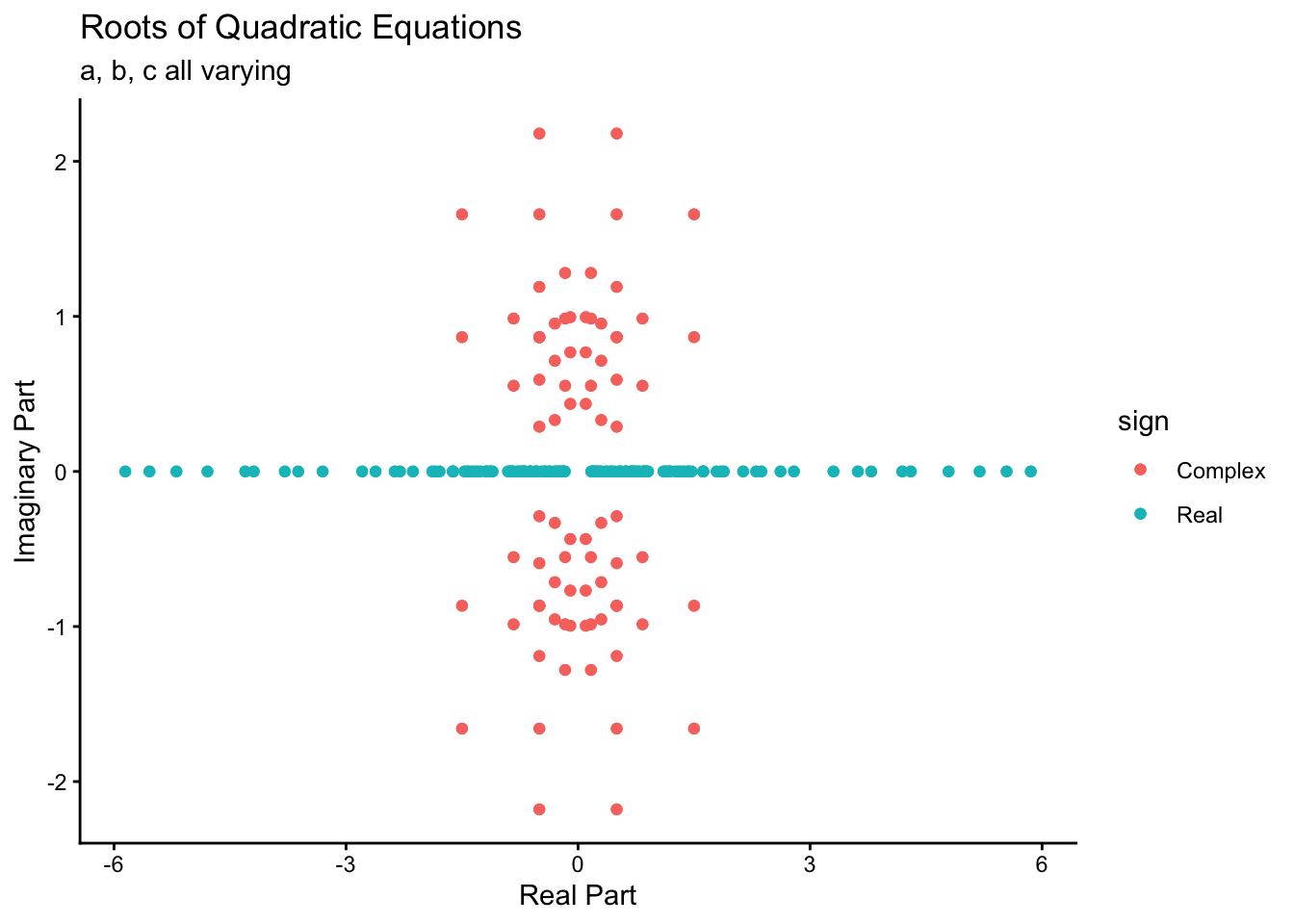
Code
# gf_text(label = ~discrim, nudge_y = 0.25) Slope b Constant, c intercept varying
Code
# Slope b = 1
expand_grid(
  a = c(1, 1,1,1,1,1),
  c = c(-5, -3, -1, 1, 3, 5),
  b = c(1, 1,1,1,1,1),
  x = list(seq(from = -5, to = 5, by = 0.1))) %>%

  dplyr::mutate(discrim = discrim(a,b,c)) %>%

  dplyr::mutate(geoms = purrr::pmap(
    .l = list(a,b,c, x),
    .f = \(a,b,c, x) tibble(x = x,
                            curve_eq = parabola(a,x),
                            line_eq = line(b,c,x),
                            quad_eq = quad_eq(a,b,c,x)))) %>%
  dplyr::mutate(roots = purrr::pmap(
    .l = list(a,b,c, discrim),
    .f = \(a,b,c, discrim) roots(a,b,c, discrim))) %>%
  unnest(roots) %>%
  select(a,b,c, discrim, Re1, Im1, Re2, Im2) %>%
  mutate(sign = dplyr::if_else(discrim < 0, "Complex", "Real")) %>%
  gf_point(Im1 ~ Re1, color = ~ sign) %>%
  gf_point(Im2 ~ Re2, color = ~ sign) %>%
  gf_labs(title = "Roots of Quadratic Equations",
          subtitle = "Slope b = 1, Intercept c varying",
          x = "Real Part",
          y = "Imaginary Part")
  # gf_text(label = ~discrim, nudge_y = 0.25)

# Slope b = 3
expand_grid(
  a = c(1, 1,1,1,1,1),
  c = c(-5, -3, -1, 1, 3, 5),
  b = 3,
  x = list(seq(from = -5, to = 5, by = 0.1))) %>%

  dplyr::mutate(discrim = discrim(a,b,c)) %>%

  dplyr::mutate(geoms = purrr::pmap(
    .l = list(a,b,c, x),
    .f = \(a,b,c, x) tibble(x = x,
                            curve_eq = parabola(a,x),
                            line_eq = line(b,c,x),
                            quad_eq = quad_eq(a,b,c,x)))) %>%
  dplyr::mutate(roots = purrr::pmap(
    .l = list(a,b,c, discrim),
    .f = \(a,b,c, discrim) roots(a,b,c, discrim))) %>%
  unnest(roots) %>%
  select(a,b,c, discrim, Re1, Im1, Re2, Im2) %>%
  mutate(sign = dplyr::if_else(discrim < 0, "Complex", "Real")) %>%
  gf_point(Im1 ~ Re1, color = ~ sign) %>%
  gf_point(Im2 ~ Re2, color = ~ sign) %>%
  gf_labs(title = "Roots of Quadratic Equations",
          subtitle = "Slope b = 3, Intercept c varying",
          x = "Real Part",
          y = "Imaginary Part")
# gf_text(label = ~discrim, nudge_y = 0.25) 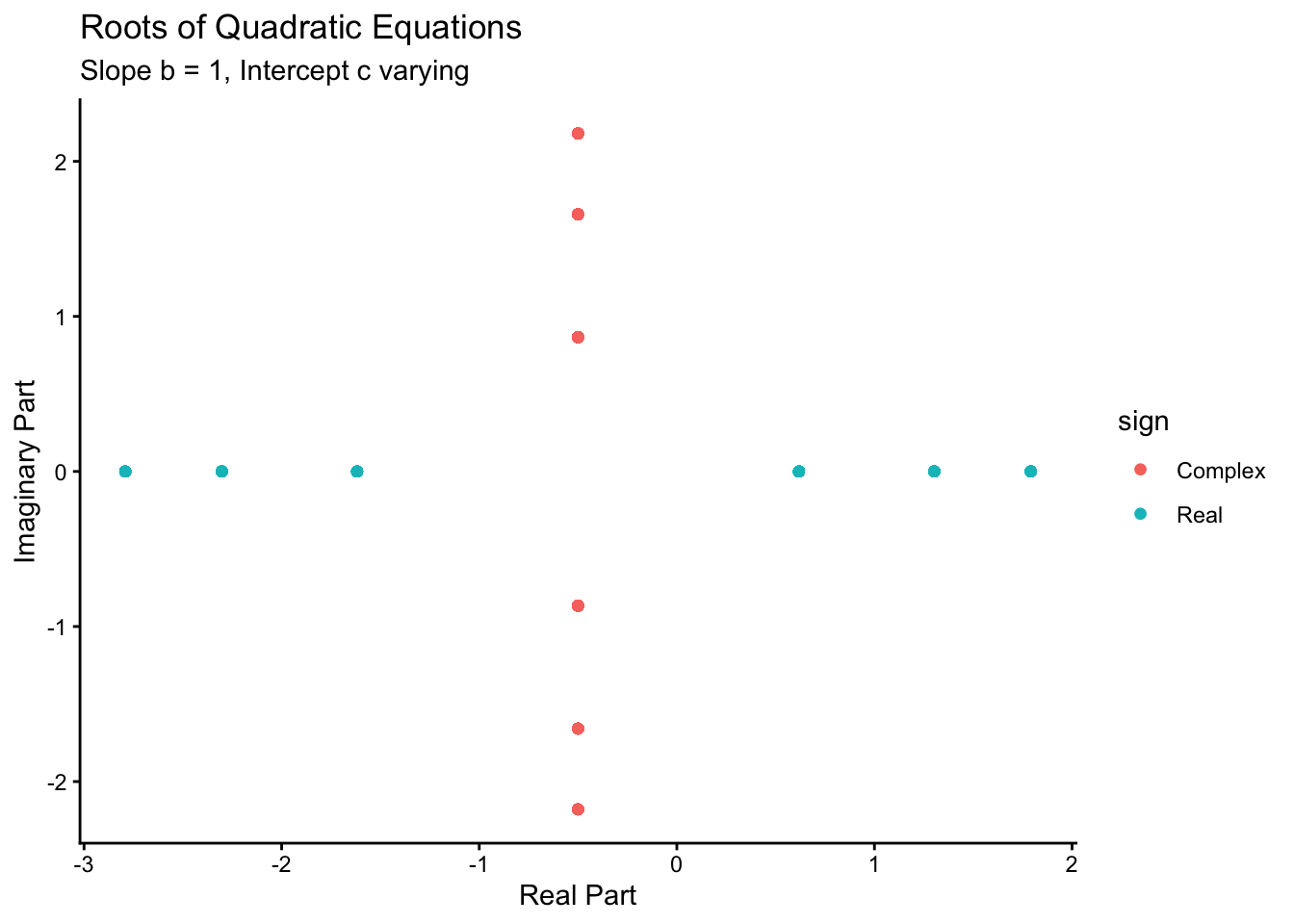
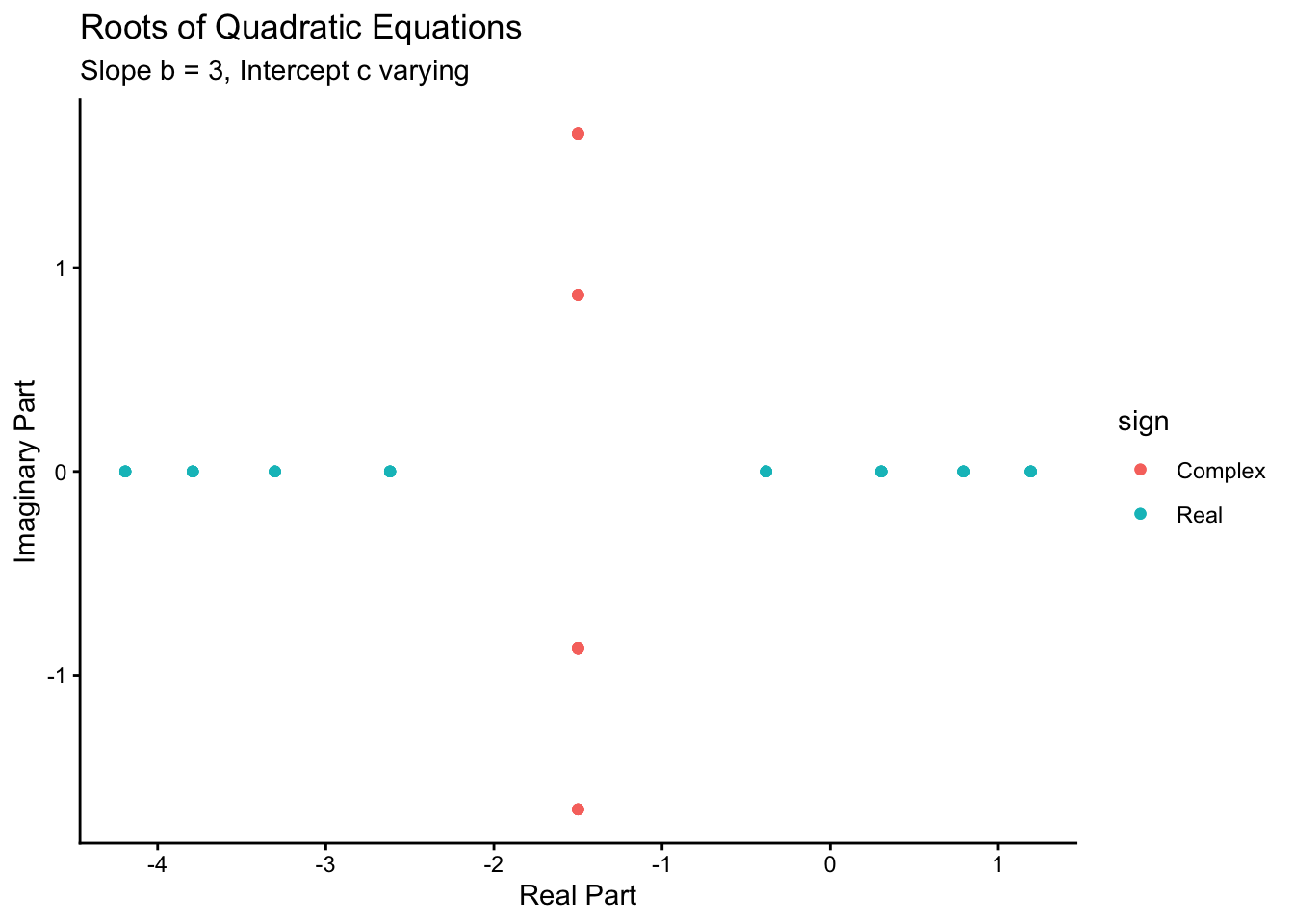
Slope b varying, intercept constant
Code
quad_data <- expand_grid(
  a = c(1, 1,1,1,1,1),
  b = seq(-3, 3, by = 0.25),
  c = c(1, 1,1,1,1,1),
  x = list(seq(from = -5, to = 5, by = 0.1)))

quad_data %>%

  dplyr::mutate(discrim = discrim(a,b,c)) %>%

  dplyr::mutate(geoms = purrr::pmap(
    .l = list(a,b,c, x),
    .f = \(a,b,c, x) tibble(x = x,
                            curve_eq = parabola(a,x),
                            line_eq = line(b,c,x),
                            quad_eq = quad_eq(a,b,c,x)))) %>%
  dplyr::mutate(roots = purrr::pmap(
    .l = list(a,b,c, discrim),
    .f = \(a,b,c, discrim) roots(a,b,c, discrim))) %>%
  unnest(roots) %>%
  select(a,b,c, discrim, Re1, Im1, Re2, Im2) %>%
  mutate(sign = dplyr::if_else(discrim < 0, "Complex", "Real")) %>%
  gf_point(Im1 ~ Re1, color = ~ sign) %>%
  gf_point(Im2 ~ Re2, color = ~ sign) %>%
  gf_labs(title = "Roots of Quadratic Equations",
          x = "Real Part",
y = "Imaginary Part") 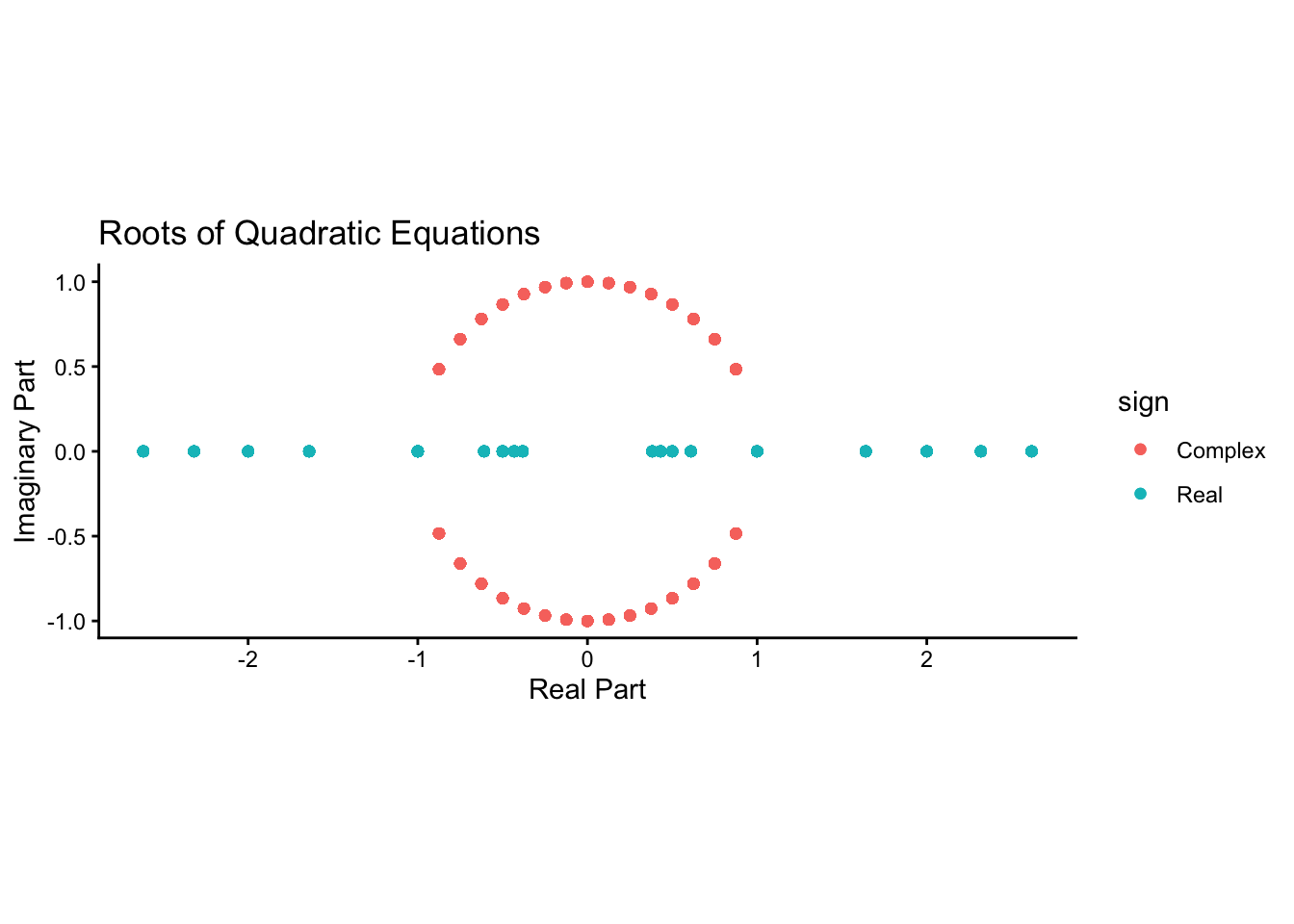
Code
# gf_text(label = ~discrim, nudge_y = 0.25) Observations
The roots of the quadratic equation seem to have a similar kind of loci as we saw ( long ago!) with Root Locus plots for control systems. The roots are real initially and converge towards zero (b = 0, c = 0; discriminant = 0) and then diverge into the complex plane as the discriminant becomes negative.
How do I plot this on a 3D plot showing the parabola (y = ax^2) and the line (y = -bx - c) intersecting in the complex plane? and how do I animate the transition from real to complex roots?